
BGaming Games in Australia: Portfolio and Catalogue Guide
 Available in US
BGaming’s current provider portfolio contains more than 250 games. Its official catalogue covers slots, casual games, cards, dice, roulette, lottery and scratch titles, and it can be explored through filters for features, volatility, mechanics, lines and themes. Supported titles also provide demo access. For an Australian reader, that makes the catalogue useful as a product research tool: it shows what BGaming develops, how games are classified and which title-level details are available.
The important limit is just as clear. BGaming is a game supplier, not a player-facing casino in this guide. A title appearing in the provider catalogue does not establish that an Australian customer can lawfully play it for real money through an online casino. Provider metadata and operator availability are different questions. This page focuses on the portfolio itself, while the Australian regulatory context is handled separately.
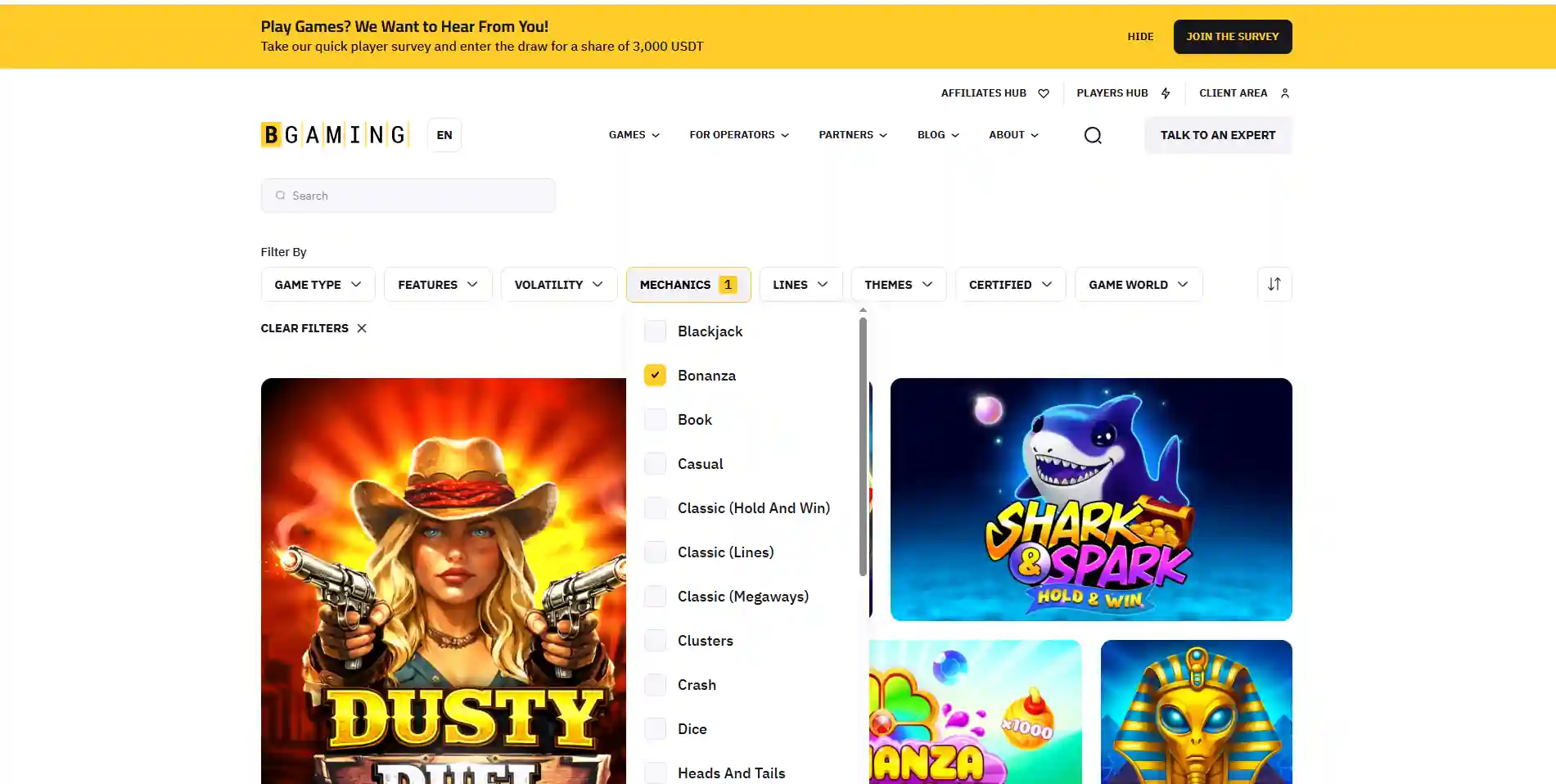
What the BGaming catalogue is actually good for
A provider catalogue is most useful when it is treated as structured evidence rather than as a casino lobby. BGaming’s current games page gives readers several ways to narrow the portfolio. The game-type layer separates broad formats, while the filter layer lets you look at mechanics, volatility, features, lines and themes. That is enough to answer practical questions such as whether a title is a slot, whether the provider labels it with a particular mechanic, and how BGaming groups products for discovery.
It also gives a cleaner basis for comparison than a long affiliate list. A third-party page may mix old titles with current releases, use its own category names, or copy a single RTP figure without explaining which build it belongs to. The provider catalogue is closer to the product source. It still needs to be read carefully, but it is the right first checkpoint for catalogue structure.
| Catalogue element | What it can tell you | What it does not prove |
|---|---|---|
| Game type | Whether BGaming currently classifies a title as Slots, Casual, Cards, Dice, Roulette, Lottery or Scratch. | That the title is offered for real-money online play to customers in Australia. |
| Mechanics and features | How a title is tagged for discovery inside BGaming’s product system. | That every operator distributes the same title, version or feature configuration. |
| Volatility | The provider’s title-level volatility label where it is shown. | A guarantee about any individual session or outcome. |
| Demo access | That a supported title can be previewed through BGaming’s demo environment. | That a player account, deposit or real-money service is being offered by BGaming. |
| RTP on a title page | A title-specific figure for the current page or build where BGaming displays it. | A safe reason to assume one provider-wide RTP or one identical configuration everywhere. |
The main categories in the 250+ game portfolio
The current BGaming portfolio is broader than a slots-only list. The official catalogue includes Slots, Casual, Cards, Dice, Roulette, Lottery and Scratch categories, while BGaming’s integration material also describes crash-style and table-game content. That breadth matters because search results for “BGaming games” often collapse very different formats into one list.
For most readers, the useful approach is to start with game type and then move down to a more specific filter. If you want reel-based titles, the dedicated pokies and slots guide explains how Australian terminology maps onto BGaming’s slot category. If you are comparing performance signals rather than catalogue size, the AU and NZ top games page keeps the regional ranking evidence in its proper combined-GEO scope.
The catalogue also helps prevent category mistakes. A casual title should not be described as a slot just because both appear on the same provider site. A roulette title should not be folded into a generic “casino game list” without preserving its actual game type. The point of the taxonomy is not to create more labels. It is to keep the evidence attached to the product category BGaming itself uses.
Classic, Casual and Entertainment: a second way to navigate
BGaming also organises its current portfolio into three Game Worlds: Classic, Casual and Entertainment. This is a portfolio strategy layer rather than a replacement for the catalogue’s basic game-type labels. A title can still be a slot or casual game at product level while also sitting inside the broader Game Worlds framework.
The distinction is useful because it explains why two games in the same technical category may be positioned differently. BGaming currently describes Classic Slots around more familiar gameplay, while Entertainment Slots are positioned around more feature-led, high-volatility, stream-oriented play. Casual is the third world in the structure. These labels are provider-side product positioning. They should not be rewritten as claims about what Australian players prefer, and they do not alter Australian rules around player-facing gambling services.
In practical terms, Game Worlds work best as a discovery lens. Use the basic catalogue category to establish what a game is, then use the Game World to understand how BGaming positions it inside the wider portfolio. That is more informative than treating all 250+ titles as one undifferentiated list.
Filters that are more useful than a giant game list
A catalogue with hundreds of titles becomes manageable only when the filters answer real questions. BGaming’s current catalogue exposes filters for features, volatility, mechanics, lines and themes. That means a reader can move from a broad category to a narrower product set without relying on an editor’s hand-picked “best games” list.
- Features
- Useful for finding titles carrying a particular provider-side feature tag. Treat the tag as catalogue metadata, not as a promise about results or availability at a casino.
- Volatility
- Useful for comparing the provider’s current labels between titles. For a fuller explanation of what the label can and cannot tell you, use the RTP and volatility guide.
- Mechanics
- Useful for separating familiar reel structures from different game systems and trademarked mechanics.
- Lines
- Useful when a slot’s pay structure is part of your comparison. It is still title-specific metadata, not a provider-wide standard.
- Themes
- Useful for discovery, but less important than game type, mechanics and current title data when you are making a technical comparison.
The catalogue also exposes demo entries on supported titles. The free demos guide explains what demo mode is useful for and why a free preview should not be confused with a real-money service.
Why title-level metadata beats provider-wide averages
Individual BGaming title pages can show fields such as game type, volatility, RTP, release date and demo access. That makes the title page the sensible place to verify a specific game’s current metadata. It is not sound to take one slot’s RTP and describe it as “BGaming RTP”, or to take one volatility label and apply it to the entire portfolio.
This is especially important when older articles remain indexed. A provider can release new builds, new titles and new mechanics while search engines continue to surface earlier summaries. When a number matters, check the current title page. When the comparison is about categories, use the catalogue. When the question is how RTP and volatility should be interpreted, use the dedicated game data page rather than averaging unlike products together.
Provider catalogue versus operator availability
One of the easiest mistakes in iGaming research is to treat a supplier’s product page as evidence that the supplier itself runs the casino service. BGaming’s own B2B integration material makes the supplier relationship clear: operators can integrate the portfolio through a single API connection. That describes how a business customer receives game content. It does not describe a BGaming player account, cashier, withdrawal process, KYC flow or bonus programme.
For Australian readers, the distinction matters because provider presence and player-facing online casino availability are not the same layer. The portfolio can be researched as software content without turning the page into a funnel for offshore real-money play. If your question is about BGaming as a company and supplier rather than about individual titles, the provider profile keeps that B2B context together.
A practical workflow for researching a BGaming title
- Start on the official catalogue and confirm the title is currently listed.
- Check the game type before using labels such as slot, casual, roulette or scratch.
- Use mechanics, features, lines and theme filters to understand how BGaming classifies the product.
- Open the individual title page if you need title-level fields such as volatility, RTP, release date or demo access.
- Do not generalise one game’s figures across the provider’s full portfolio.
- Keep regional sales or ranking data separate from catalogue metadata. Combined Australia-and-New-Zealand evidence belongs on the regional ranking page.
- Keep player-facing legal and licence questions separate from product discovery. The licence and trust guide covers that layer.
This workflow is deliberately less exciting than a “top 50 games” list, but it produces cleaner answers. It tells you what is current, what is title-specific, what is a provider classification and what requires a different source.
Mobile and delivery are separate questions
A catalogue can tell you what games exist, but delivery is another layer. Mobile compatibility concerns how content is delivered and displayed across devices, not whether the provider has created a separate Australian casino app. The mobile compatibility guide deals with that question without turning BGaming into a B2C operator.
The same separation applies to integration. A single B2B API can give an operator access to the provider portfolio, yet an individual operator still decides what it distributes within its own technical, commercial and regulatory setup. That is why a supplier-side list should never be copied directly into a claim that every title is available everywhere.
How to read catalogue changes over time
A provider catalogue is a moving product record, not a fixed encyclopaedia. BGaming continues to add releases to a portfolio that already exceeds 250 games, so the value of a catalogue check is partly its date. An archived catalogue view, spreadsheet or article can be accurate when published and still become incomplete after new titles are added. For that reason, use the live catalogue to confirm current category membership before treating an older game list as complete.
The same principle applies to filters. If a title is reclassified, receives a new product page or appears under a newer mechanic label, the current provider page should take priority over an old summary. That does not mean every old source is useless. Historical material can show how the portfolio developed, but current product claims should stay anchored to the current catalogue.
There is also a practical difference between a catalogue update and a regional performance update. The catalogue tells you what BGaming currently lists and how it describes the product. A monthly or periodic regional report tells you how selected titles ranked in a defined GEO and period. Those are two different evidence types. Mixing them can create claims the sources never made, such as assuming a newly listed game is regionally popular or assuming a top-ranked regional title represents the whole global portfolio.
For ongoing research, record the check date, preserve the exact title spelling and keep the source type attached to the claim. That makes later updates much easier: you can refresh a category or title field without changing unrelated statements about the provider.
FAQ
How many games does BGaming currently have?
BGaming’s current portfolio contains more than 250 games. The provider describes a catalogue spanning slots, casual and crash-style games, cards, dice, roulette, lottery and scratch content.
Does the BGaming catalogue show only slots?
No. Slots are a major category, but the current catalogue also separates several non-slot game types. That is why using the official game-type filters is more accurate than calling every title a pokie.
Can I use the catalogue to check RTP and volatility?
Use the catalogue to narrow titles and the individual game page for title-specific metadata where BGaming displays it. Do not infer a provider-wide RTP or volatility figure from one game.
Does a game appearing on BGaming’s site mean Australians can play it for real money online?
No. Catalogue presence is provider-side product evidence. Real-money availability to customers in Australia is a separate operator and regulatory question.
Bottom line
BGaming’s 250+ game portfolio is best read as a structured provider catalogue. Start with game type, use the filters to narrow mechanics and features, use Game Worlds as a positioning layer, and verify important title data on the current game page. For Australian research, keep that product evidence separate from operator availability and legal access. That single distinction removes most of the confusion created by generic “BGaming game list” pages. For the wider provider and Australian context, return to the BGaming Australia guide.
BGaming Games in Australia: Portfolio and Catalogue Guide
Content created by the «bgamingcasinoau.com» team