
BGaming as a Game Provider: Company, Technology and Three Game Worlds
 Available in US
BGaming is a B2B game provider operated by Stable Games Ltd, not a player-facing online casino. The BGaming brand made its official debut as an independent studio in 2018, and its current provider portfolio contains more than 250 games. Operators can connect that catalogue through a single API integration, while BGaming now organises its product strategy into three Game Worlds: Classic, Casual and Entertainment.
That distinction matters for Australian readers because provider search results can easily be mistaken for casino-operator information. BGaming develops and supplies game content. It does not run Australian player accounts, accept deposits or process withdrawals through its own website. The useful questions are therefore who the supplier is, how its content reaches third-party platforms, how the portfolio is structured, and what provider-level evidence can actually tell you.
BGaming at a glance
| Provider fact | Current position | What it means |
|---|---|---|
| Operating entity | Stable Games Ltd | The legal entity behind the BGaming website and B2B game supply. |
| Brand debut | 2018 | BGaming describes 2018 as the official debut of the independent studio. |
| Headquarters and development offices | Headquartered in Malta, with development offices in Poland and Georgia | This is the current company-location information published by BGaming. |
| Portfolio size | 250+ games | The count is provider catalogue scale, not the number of games at any one casino. |
| Distribution model | Single API integration for operators | Operators and platforms can connect the BGaming catalogue through one B2B integration layer. |
| Portfolio framework | Classic, Casual and Entertainment | BGaming uses Three Game Worlds to group products by role and style. |
These facts are provider-level facts. None of them establishes that BGaming itself operates a consumer gambling service in Australia. They describe the supplier, its catalogue and its distribution architecture.
Who operates BGaming?
BGaming’s current Terms of Use identify the website as operated by Stable Games Ltd. The same Terms say the company operates exclusively as a business-to-business games provider and does not provide or facilitate consumer gambling services. That is the most important classification on this site because it changes how almost every other BGaming fact should be interpreted.
A casino operator typically owns or controls the customer relationship: registration, account balances, deposits, withdrawals, bonuses, account verification and responsible gambling controls. A game provider sits earlier in the supply chain. It develops game content and makes that content available to operators or platforms through technical integrations and commercial agreements.
For that reason, questions about BGaming deposits, BGaming withdrawals or a BGaming Australian welcome bonus are based on the wrong company role. Those functions are not part of the BGaming provider service. If a third-party casino offers a BGaming title, the surrounding account and payment features belong to that operator, not to BGaming.
From studio to operator to player: the supplier chain
The cleanest way to understand BGaming’s B2B model is as a three-layer chain. At the first layer, BGaming creates and maintains the game content. At the second layer, an operator, aggregator or platform integrates that content into its own service. At the third layer, an end user may encounter the game inside the operator’s interface, subject to the operator’s terms and the law that applies to that service.
- Provider layer: BGaming develops games, publishes product metadata, maintains releases and supplies the integration.
- Platform or operator layer: a third party decides which integrated titles to surface, how the lobby is organised and which account functions surround the games.
- Consumer layer: the end user’s relationship is with the operator service, not with BGaming merely because a BGaming title appears there.
This model explains why the same BGaming title can appear in different interfaces with different surrounding account tools. The game provider remains the same, but the operator layer can vary substantially. It also explains why a cashier, bonus page or account dashboard should not automatically be described as a BGaming feature.
What one API integration means in plain English
BGaming’s current integration page says operators can access a portfolio of more than 250 titles through one unified API connection. The technical material refers to game launches, transaction synchronisation and reporting. For a non-technical reader, the key idea is that an operator does not need a completely separate connection for every BGaming release.
An API is a structured way for software systems to exchange instructions and data. In this case, the integration sits between BGaming’s game infrastructure and the operator or platform. It supports launching games and handling the technical messages needed for those launches inside the operator environment.
The benefit for understanding the provider model is not the sales claim that integration is convenient. It is the architectural implication: BGaming can update and expand its catalogue while operators continue to use the same broad integration path. That is why provider content can scale across multiple third-party services without BGaming becoming the operator of those services.
The same integration material also describes desktop and mobile compatibility for game launches. The mobile delivery guide explains that point separately, because device compatibility is a content-delivery fact and should not be confused with a BGaming consumer casino app.
The 250+ portfolio is a supplier catalogue, not one casino lobby
BGaming’s current company and integration pages both describe a portfolio of more than 250 games. The official BGaming games catalogue lets readers inspect the provider’s own taxonomy rather than relying on a third-party lobby. That is the right level for questions such as which game types BGaming develops, which mechanics appear in the catalogue, and how the studio groups its current products.
The distinction between provider catalogue and operator lobby matters because an operator may carry only a subset of the portfolio. Commercial agreements, integration choices, local rules and operator product decisions can all affect which titles appear in a particular service. A 250+ provider portfolio therefore should not be rewritten as “250+ games available at every casino”.
The catalogue is also more useful as an evidence source than as a raw count. It exposes game categories and product metadata that can be checked at title level. The supporting pages on BGaming demos, mobile delivery and game data use that provider-side evidence rather than inventing operator features.
Three Game Worlds: BGaming’s current portfolio strategy
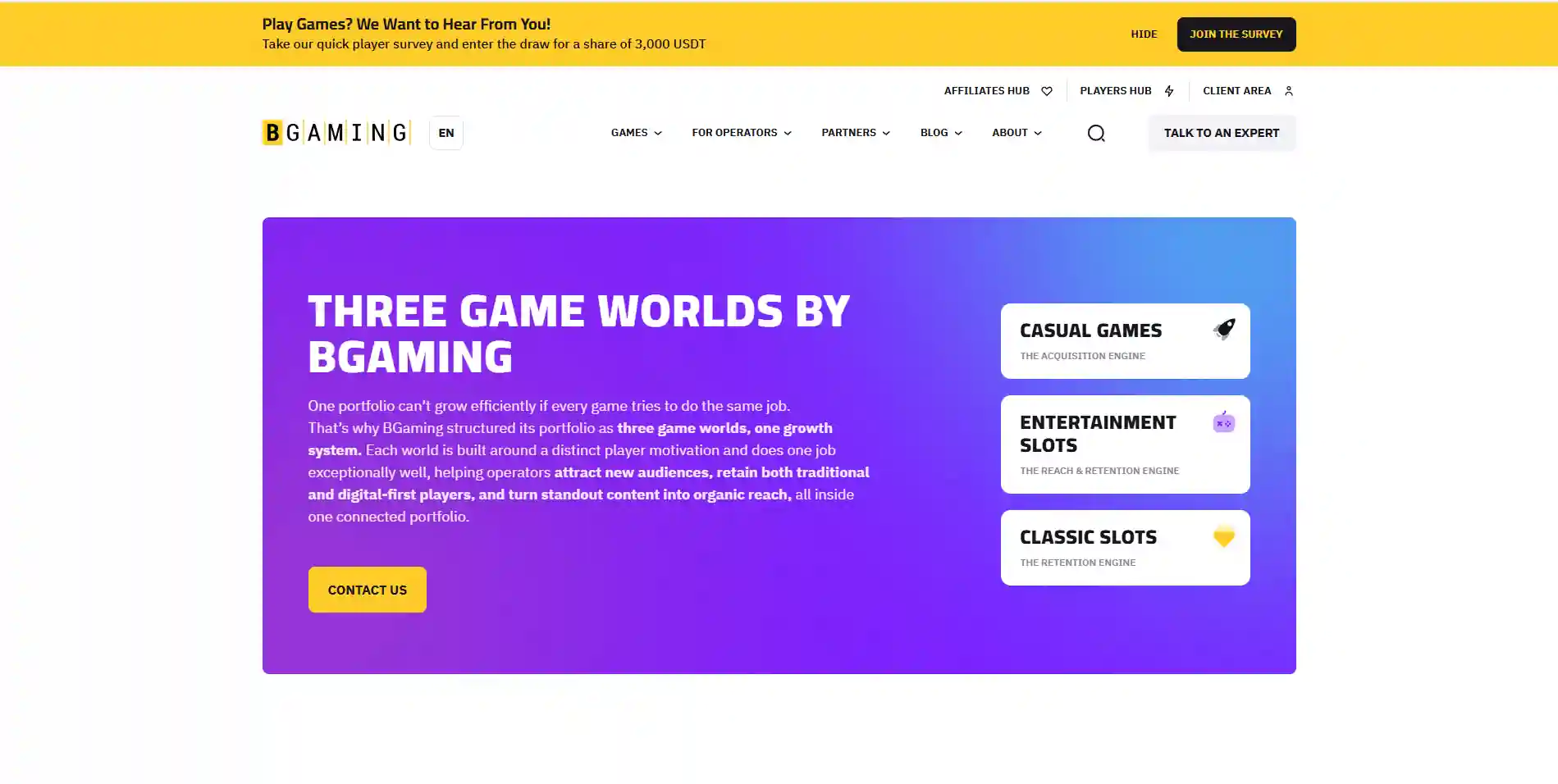
BGaming’s current Three Game Worlds page divides the portfolio into Classic, Casual and Entertainment. The company describes the framework as a way to give different parts of the catalogue distinct roles rather than treating every release as if it serves the same purpose.
| Game World | BGaming’s current positioning | How to read it editorially |
|---|---|---|
| Classic | Familiar slot formats and retention-focused positioning | A category for more traditional slot presentation and established mechanics. |
| Casual | Simple-entry, mobile-friendly and fast-understood formats | A category that includes lighter game structures and casual mechanics rather than only reel slots. |
| Entertainment | Digital-first, streaming-friendly slot content with more dramatic features | A category for higher-impact slot presentation and mechanics designed around visibility and engagement. |
The categories are BGaming’s own portfolio framework, not an Australian regulatory classification and not a quality ranking. “Classic” does not mean legally safer, “Casual” does not mean financially low risk, and “Entertainment” is not a licence category. The value of the framework is organisational: it shows how the supplier currently thinks about product roles inside one catalogue.
BGaming was still actively using the Three Game Worlds framework in August 2026. A company update published on 26 August 2026 again describes Classic, Casual and Entertainment as a flagship portfolio strategy, which matters because portfolio frameworks can change faster than company identity facts.
Why Australia and New Zealand product data does not make BGaming an Australian casino
BGaming publishes product-performance material that combines Australia and New Zealand as a regional GEO. The AU and NZ top games page analyses that material with the correct combined scope. The existence of regional product data is consistent with a B2B supplier model: providers can analyse where integrated content performs without becoming the direct account operator in each market.
That is an important distinction when search results use phrases such as “BGaming Australia”. A provider can have Australian market relevance through distribution, product interest or regional reporting. Those signals do not establish that BGaming itself opens Australian gambling accounts or that any third-party real-money service offering its games is lawful.
The legal and licence questions are intentionally separated into the BGaming licence page. Keeping them separate prevents technical distribution, market reporting and licensing from being collapsed into one misleading “available” or “legal” label.
What the provider model lets you verify
A provider-first review can answer several questions with relatively strong evidence. It can verify the legal entity named in the provider’s Terms, the provider’s current catalogue size, the public game taxonomy, the existence of the single-API integration, the Three Game Worlds framework, individual title metadata and the scope of BGaming’s own demo environment.
It cannot safely infer operator-specific terms from those facts. A provider page does not establish the minimum deposit at a third-party casino, withdrawal limits, bonus eligibility, player support hours, account verification rules or which payment methods an operator accepts. Those are different facts attached to a different service.
Company history without filling the gaps
BGaming’s current About page says the brand made its official debut in 2018. It also says the company is headquartered in Malta, with development offices in Poland and Georgia. Those are the location and history facts used here because they are supported by the current official source.
This page does not add an Australian office, Australian staff count, revenue figure, ownership structure or local partnership list. Those details are not required to answer the provider question, and adding them without a specific supporting source would reduce rather than improve information quality.
The same discipline applies to broad corporate language. BGaming’s own marketing describes global reach and operator relationships, but this review focuses on the facts that help a reader understand the supplier role rather than reproducing business-development claims.
How to read a BGaming page or interface correctly
- Identify whether the page belongs to BGaming itself or to a third-party operator.
- Check whether the subject is provider content, such as a game, API, catalogue or demo, or an operator function such as a cashier or account page.
- Use the provider’s own page for current game and catalogue metadata where possible.
- Do not transfer operator terms back to BGaming simply because the operator carries BGaming content.
- For licence questions, use regulator records rather than marketing language.
- For Australian service-law questions, use current Australian regulatory sources rather than the provider’s technical distribution claims.
This method is especially helpful when provider and casino terminology are mixed in search results. It keeps each claim attached to the organisation and service layer that actually supports it.
Primary sources checked for this provider profile
- BGaming Terms of Use for Stable Games Ltd and the B2B-only website/service scope.
- BGaming About for the 2018 debut, company locations and 250+ portfolio statement.
- BGaming games integration for the single-API delivery model and current portfolio scale.
- BGaming Three Game Worlds for the current Classic, Casual and Entertainment framework.
FAQ
Is BGaming an online casino?
No. BGaming’s current Terms describe Stable Games Ltd as operating exclusively as a B2B games provider. The BGaming website does not itself operate real-money gambling or wagering services.
Who operates BGaming?
BGaming’s Terms identify Stable Games Ltd as the company operating the website and provider service.
When did BGaming launch?
BGaming’s current company page describes 2018 as the brand’s official debut as an independent game studio.
How many games does BGaming have?
Current official company and integration material states that the portfolio contains more than 250 games.
What are the Three Game Worlds?
They are BGaming’s current Classic, Casual and Entertainment portfolio categories. They organise product strategy and should not be treated as legal or safety classifications.
Does one API mean BGaming runs the casino account?
No. The API is a B2B content integration. The surrounding account, payments and consumer service belong to the operator or platform.
Bottom line
BGaming is best understood as the B2B supplier behind a 250+ game catalogue, operated by Stable Games Ltd and distributed to operators through provider integrations. Its current portfolio strategy is organised around Classic, Casual and Entertainment Game Worlds. Those facts explain the company and technology layer without turning BGaming into a casino operator it is not. For the wider Australian context, return to the BGaming Australia guide.
For Australian readers, the practical rule is simple: keep provider facts, operator services and Australian law as separate questions. Use the catalogue for game information, the provider pages for company and integration facts, and the licence and trust guide for regulator-level questions.
Recommend
Content created by the «bgamingcasinoau.com» team